
Party gaming on the Nintendo Switch has evolved into something genuinely special. What started as a novelty for casual players has become the go-to platform for group entertainment, from couch co-op chaos to competitive showdowns that keep everyone engaged for hours. Whether you’re hosting friends, family, or a mix of skill levels, the Switch’s library of party games offers something that actually works, not just technically but socially. The beauty of Nintendo Switch party games is their accessibility: anyone can pick up a Joy-Con and participate within seconds, yet they offer depth for players who want to master mechanics or strategies. This guide covers 15+ essential titles across every category, from laugh-out-loud trivia games to intense competitive battles, so you’ll find the perfect fit for your next gathering.
Table of Contents
ToggleKey Takeaways
- Nintendo Switch party games combine accessibility with depth, allowing newcomers to join instantly while offering mastery opportunities for experienced players.
- The best party games support flexible player counts, offer replayability through varied modes and randomization, and create memorable social moments over technical perfection.
- Top-tier Nintendo Switch party games like Mario Party Superstars, Mario Kart 8 Deluxe, and Jackbox Party Packs deliver distinct experiences—from luck-based chaos to competitive racing to smartphone-controlled creativity.
- Cooperative titles like Overcooked 2 and Lovers in a Dangerous Spacetime build team cohesion by making players succeed or fail together, avoiding frustration from skill gaps.
- Successful party hosting requires matching your guest list’s skill levels and preferences to game selection, plus thoughtful setup with quality displays, multiple controllers, and strategic game rotation to keep energy high.
- Hidden gems like Keep Talking and Nobody Explodes and Fibbage XL offer unique asymmetrical and deduction-based gameplay that often outperform blockbusters in memorability and inclusive fun.
What Makes a Great Nintendo Switch Party Game
Not every multiplayer game qualifies as a genuine party game. The best ones share specific qualities that elevate the experience from mere entertainment to something memorable. Understanding these criteria helps you identify which titles deserve shelf space and which ones might disappoint mid-party.
Accessibility and Easy-to-Learn Controls
The moment someone unfamiliar with gaming picks up a Joy-Con, the party game must communicate its controls instantly. Great party games use simple button layouts, usually just directional inputs, one or two action buttons, and maybe a shoulder button for special moves. Games like Mario Kart 8 Deluxe don’t require tutorials: players intuitively understand that steering left makes them go left. This doesn’t mean the games are shallow, accessibility and depth coexist beautifully when designed correctly. A newcomer can jump into a race and have genuine fun on their first lap, while experienced players exploit shortcuts, timing, and racing lines. The same principle applies to party games across genres: lower barriers to entry, infinite ceilings for mastery.
Multiplayer Support and Player Count Options
Flexibility in player count separates exceptional party games from mediocre ones. Games should smoothly support 2 players for intimate sessions, scale to 4+ players for group chaos, and ideally offer spectator modes so people waiting for their turn stay invested. Super Smash Bros. Ultimate lets up to 8 controllers connect simultaneously, supports free-for-all and team battles, and even allows non-players to influence outcomes via items and hazards. Not every game needs to support 8 players, but the core party experience shouldn’t collapse if someone shows up unexpectedly. Likewise, online multiplayer has become essential, sometimes people can’t gather in person, so robust online matchmaking and friend lobbies matter more than ever.
Replayability and Varied Game Modes
The difference between “fun once” and “fun forever” is replayability. Party games thrive when they offer multiple modes, rotating objectives, randomized elements, or progression systems that reward repeated play. Mario Party Superstars ships with 100+ mini-games and multiple board formats, so 10 consecutive matches feel genuinely different. Randomization (RNG) gets a bad reputation in competitive circles, but in party games, it’s often the secret sauce, a trailing player can catch up via luck, keeping everyone emotionally invested until the final moments. Seasonal updates, cosmetic unlocks, and new content keep player bases engaged long-term. Games with robust single-player modes or campaign experiences also extend value beyond group sessions.
Best Party Games for Group Fun and Laughter
These titles live for the chaos, they’re designed to create unforgettable moments, inside jokes, and genuine belly laughs. These are the games people remember months later, not because they’re mechanically brilliant but because they generate stories worth retelling.
Mario Party Superstars
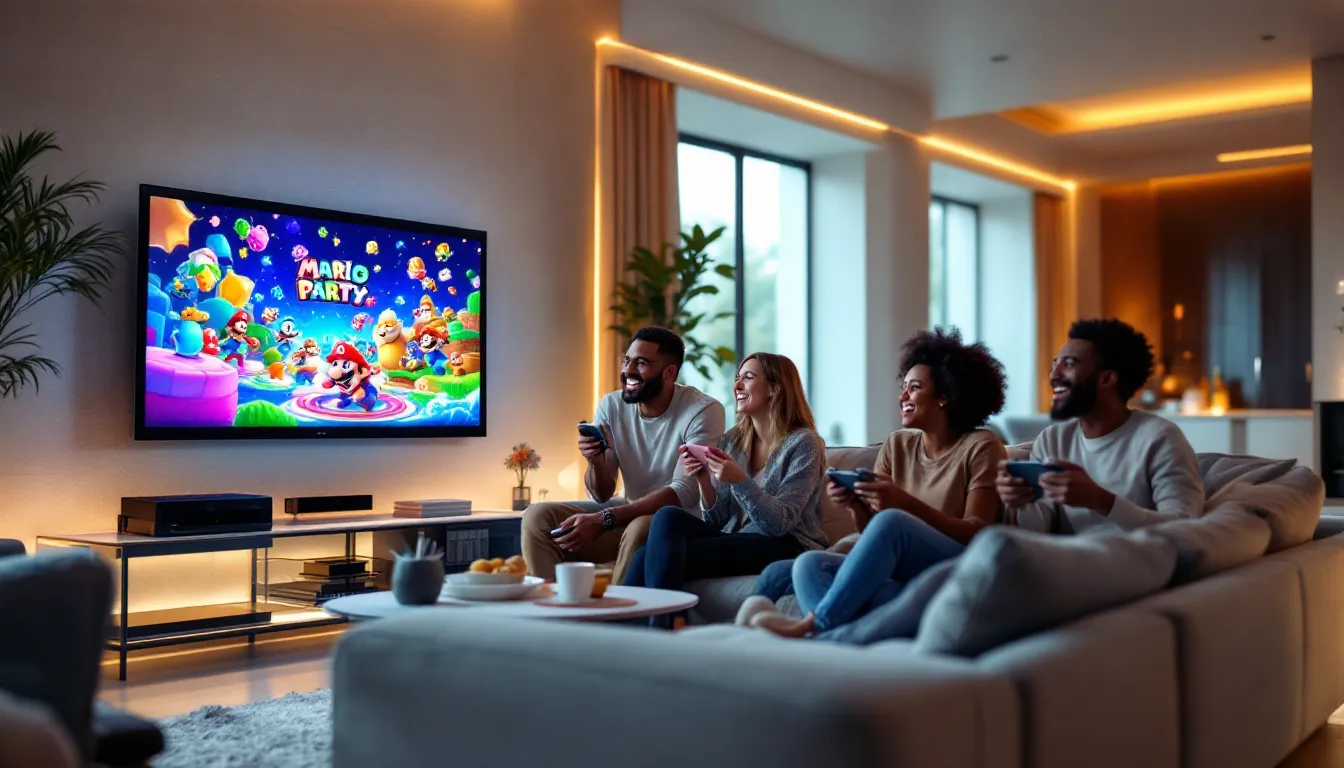
Mario Party Superstars (2021) is the definitive modern Mario Party experience, curating the best 100 mini-games from across the franchise’s history. Four players navigate a board, mini-games determine turn outcomes, and pure randomness ensures anyone can win on the final turn. The genius is the tension: early-game strategy matters, but luck reigns supreme, which means no one’s eliminated from victory until the credits roll. Controller motion controls work for some mini-games (rhythm-based challenges, dexterity tests), while button-mashing works for others, ensuring accessibility. Local multiplayer is flawless, up to four Switch controllers or Joy-Con pairs. Online multiplayer exists but feels secondary: Mario Party Superstars truly shines with friends physically present. The game shipped with 80 mini-games initially, and post-launch updates added 20 more, keeping the experience fresh. If you buy one party game, this should be it.
Jackbox Party Packs
The Jackbox Party Packs (5, 8, and 9 are current standouts) revolutionized couch party gaming by reducing the controller barrier to nearly zero. Players use smartphones or tablets as controllers, meaning up to 10+ people can participate simultaneously. Games like Fibbage XL (bluffing-based trivia), Quiplash (rapid-fire joke writing), and Bracket Racket (collaborative elimination) are laugh factories because they reward creativity and humor over mechanical skill. The Steam Deck integration and mobile web-based controls mean accessibility has never been better, someone across the country can join remotely via streaming. Jackbox Party Pack 9 (2023) refined the formula further, with 5 distinct games and improved UI. Party Packs 5 and 8 both contain fan-favorite mini-games: choose based on which specific games appeal to your group. High production values, witty writing, and genuine unpredictability make these absolute must-haves for any party collection.
Moving Out
Moving Out (2020) is a cooperative puzzle-platformer where 1–4 players move furniture out of increasingly chaotic houses. It sounds simple, grab a couch, carry it out the door, but obstacles escalate rapidly: slippery floors, gravity shifts, hostile neighbors, and absurd level designs transform the experience into controlled pandemonium. Communication and timing become essential: one player misaligning a grand piano mid-staircase cascades into hilarious failure. The visual style is charming, controls are responsive, and the difficulty curve respects newcomers while challenging veterans. With fighting games for Nintendo Switch, competitive titles dominate, but Moving Out proves cooperative chaos is equally potent. Local co-op is the intended experience (up to 4 Joy-Cons), though online multiplayer is available. The campaign spans 40+ levels, plus bonus challenges, ensuring multiple play sessions. If your group prefers cooperation over competition, Moving Out delivers.
Top-Rated Sports and Competitive Party Games
When the gloves come off and winning becomes personal, these titles deliver adrenaline-fueled competition. They’re less about laughing at randomness and more about outplaying opponents through skill, timing, and strategy. The Switch excels in this space, offering arcade-style sports that prioritize fun over simulation.
Mario Kart 8 Deluxe
Mario Kart 8 Deluxe (2017, continuously updated) remains the definitive battle royale racing game on Switch and arguably the best entry point for competitive gaming on the platform. Twelve players race simultaneously across vibrant tracks, collecting items, exploiting shortcuts, and wielding power-ups in real-time. Mechanically, it’s forgiving enough for newcomers, accelerate, steer, use items, yet offers depth through drifting mechanics, precise line-taking, and item timings that separate casual racers from champions. The battle modes (Balloon Battle, Renegade Roundup, Shine Thief) shift focus from raw speed to positioning and item management, creating different competitive layers. Online multiplayer supports up to 12 players across regions, with skill-based matchmaking that scales difficulty appropriately. Local multiplayer supports split-screen, handheld, or standalone Joy-Con play, accommodating almost any hardware configuration. With 48 tracks, 42 characters, and multiple cup rankings, MK8D has justified countless hours since its launch. Regular patches balance overpowered items and characters, keeping the competitive landscape fresh. It’s industry-standard party racing.
Nintendo Switch Sports
Nintendo Switch Sports (2022) launched as Nintendo’s answer to Wii Sports nostalgia, offering six sports (tennis, badminton, volleyball, soccer, bowling, and golf) with motion controls as the primary input method. Where Wii Sports demanded actual arm motion, Switch Sports refines this: flicking a Joy-Con initiates swings and passes, but timing and precision matter more than raw motion. Tennis matches pit up to four players in chaotic rallies, badminton plays similar but with net positioning logic, volleyball emphasizes team coordination, and soccer brings arcade chaos. Golf is surprisingly deep, with spin mechanics and pin positioning rewarding practice. Motion controls occasionally register oddly, but the core experience remains accessible and genuinely fun. Online multiplayer is stable, supporting ranked matches for players who want competitive progression. The title later received a golf expansion featuring professional courses and expanded mechanics. Local multiplayer is where Switch Sports shines, instant gratification, minimal setup, immediate understanding of what’s happening. It’s lighter than Mario Kart but heavier than party mini-game collections.
Super Smash Bros. Ultimate
Super Smash Bros. Ultimate (2018) is the largest fighting game ever created: 89 characters, hundreds of stages, countless cosmetics, and mechanics balancing accessibility with tournament-level depth. But, for party contexts, Ultimate is less about frame-data analysis and more about controlled chaos: up to 8 players can fight simultaneously, Smash Balls spawn random power-ups, stage hazards create unpredictable moments, and Item sets range from realistic to absurd. For casual groups, the massive character roster means everyone finds someone they vibe with. Cloud might appeal to JRPG fans, Samus to action-game veterans, Pokémon trainers to franchise loyalists. The party mode includes Squad Strike (team elimination), Cruel Melee (chaos survival mode), and classic arcade-style runs. But, Ultimate requires controller investment, Joy-Con work but feel cramped for extended sessions: Pro Controllers or GameCube controllers are recommended. The learning curve for competitive play is steep, but party play with items enabled is gleefully chaotic. Online ranked modes exist for serious players, while casual lobbies welcome button-mashers. Fighting games for Nintendo have exploded in popularity, and Ultimate remains the platform’s heavyweight champion, not just mechanically but culturally.
Party Games Perfect for All Ages
These titles bridge generational gaps. Grandparents, teenagers, and toddlers can coexist in the same play session without anyone feeling excluded. They’re timeless in design, challenging enough for adults, welcoming enough for kids, and colorful enough that everyone wants to participate.
Animal Crossing: New Horizons
Animal Crossing: New Horizons (2020) might not seem like a party game, it’s fundamentally solo-focused, but its Dodo Code visiting system transforms it into a unique social experience. Up to eight players can visit a friend’s island simultaneously, exploring, catching fish, shaking trees, and admiring custom decorations without direct competitive pressure. It’s collaborative tourism rather than traditional gameplay. Parents love that it’s violence-free and non-threatening: kids love the creative freedom and adorable characters. Adults find zen in the rhythm-game-like fishing and bug-catching mechanics, plus the island customization goes absurdly deep. While not a traditional party game, there’s no win condition or structured competition, the social atmosphere makes it valuable for multi-generational gatherings. The cozy vibes and low-stress environment mean it’s an excellent palate cleanser between more intense games. Recent updates added cooking, swimming, and island tours, extending longevity. New Horizons proves that “party games” don’t require scoreboards or competitive mechanics.
Super Mario Party
Super Mario Party (2018) is the spiritual predecessor to Superstars, featuring different boards and mini-games. Four players navigate boards, collect stars, and compete in mini-games with mechanics ranging from dexterity (button-mashing races) to luck (spinning wheels). Younger players love the colorful presentation and low barrier to entry: older players appreciate the strategic board-game layer. Partners mode introduces team-based play, softening the solo competitive edge. Online multiplayer exists but is limited compared to local play, where the game truly shines. The motion-controlled mini-games work well and feel intuitive. While Superstars technically refines the formula, Super Mario Party holds its own and often appears at lower prices, making it a solid alternative if Superstars is unavailable. Both are excellent for all-ages groups.
Overcooked 2
Overcooked 2 (2018) is a cooperative cooking-management game where 1–4 players work together to prepare meals, plate dishes, and serve customers before timers expire. The chaos scales perfectly: single-player feels achievable, two-player requires synchronization, three-player introduces communication breakdowns, and four-player becomes beautiful anarchy. Stages introduce mechanics that force adaptation, dynamic kitchens, conveyor belts, ghost dimensions, keeping the experience fresh across dozens of levels. The game respects skill gaps: difficulty modes adjust customer demand, so everyone contributes meaningfully. Later levels demand precision and communication, but early levels welcome button-mashers. The art style is charming, the sound design is satisfying, and the victory moments (completing a final order with seconds on the clock) create genuine celebration. Online co-op is excellent, allowing remote friend sessions. Unlike competitive games where skill differences create frustration, Overcooked 2’s cooperative structure means everyone succeeds or fails together, building team cohesion. It’s the gold standard for couch co-op gaming.
Hidden Gems and Underrated Party Titles
Beyond the obvious blockbusters, the Switch library harbors lesser-known gems that deliver outsized party value. These titles often lack the marketing budgets of Nintendo’s tentpole franchises but punch well above their weight in terms of fun-per-dollar.
Fibbage XL and Other Jackbox Favorites
While the broader Jackbox Party Packs receive visibility, Fibbage XL specifically deserves highlighting as a masterclass in party game design. Players read statements (historical facts, trivia questions, funny prompts) and create plausible-sounding lies to fool others into selecting them instead of the truth. It’s a social deduction game disguised as trivia, rewarding creativity and reading people’s tendencies rather than factual knowledge. A player’s confidence in their lie often matters more than its believability, deliver it with conviction and others second-guess themselves. The randomized statements ensure no two games play identically. Since Jackbox games use smartphones as controllers, setup is frictionless, and up to 10 people participate. Other standout Jackbox titles include Quiplash (joke writing), The Wheel (spinning random categories for absurd answers), and Bracket Racket (collaborative bracket-building debates). The variety across packs means multiple purchases aren’t redundant, they’re cumulative fun. DualShockers frequently highlights Jackbox as essential party software, and for good reason.
Lovers in a Dangerous Spacetime
Lovers in a Dangerous Spacetime (2015) is a chaotic co-op space-exploration game where 1–4 players man a colorful spacecraft, manning weapons, shields, engines, and other stations simultaneously. Success requires communication, someone runs engines while another manages shields and a third fires weapons. With only a few players, constant position-switching creates frantic energy: with four players, roles stabilize and teamwork becomes elegant. The visual aesthetic is gorgeous: vibrant space, cute alien creatures, satisfying explosions. Difficulty ramps gracefully, and boss battles demand coordination. Crucially, the game respects different skill levels: players alternate roles, ensuring everyone pilots, fires, and shields at some point. Online co-op is available, but local play is the intended experience. The soundtrack is excellent, the controls are responsive, and the game respects player time, campaigns finish in 2–3 hours. For groups that loved Overcooked but want something different, Lovers in a Dangerous Spacetime is a natural follow-up.
Keep Talking and Nobody Explodes
Keep Talking and Nobody Explodes (2015) is a asymmetrical co-op experience where one player sees a bomb with multiple modules and another player reads a physical manual, providing clues without seeing the screen. Communication becomes critical: the bomb-defuser asks questions and the manual-reader provides guidance, racing against a timer. With clever design, module complexity scales with subsequent plays, meaning experienced players increase difficulty intentionally. It’s portable, the manual is available digitally on phones or tablets, so setup is minimal. Teams can compete to see who defuses bombs fastest. The experience is hilarious, tension-filled, and genuinely memorable. Unlike traditional games, expertise comes from understanding the game rather than manual dexterity, meaning age and gaming background matter less. It’s probably the most unique entry on this list. Destructoid has praised asymmetrical co-op as an underexplored party game genre, and Keep Talking exemplifies why.
How to Choose the Right Party Game for Your Group
With dozens of compelling options, narrowing down your collection requires understanding your specific social context. Different groups have different needs, and the “best” party game depends entirely on who’s playing.
Consider Your Guest List and Skill Levels
A gathering of hardcore fighting game competitors has wildly different needs than a multi-generational family reunion. If your group includes people who rarely game, prioritize titles with minimal learning curves: Mario Kart 8 Deluxe, Jackbox Party Packs, and Nintendo Switch Sports welcome newcomers without condescension. If everyone’s experienced, competitive games like Super Smash Bros. Ultimate and Mario Kart 8 Deluxe’s battle modes respect mechanical depth. Mixed-skill groups benefit from luck-heavy titles like Mario Party Superstars, where randomness prevents skill-based snowballing. Consider age ranges too, young children thrive with Animal Crossing: New Horizons and Overcooked 2, teenagers gravitate toward competitive combat, and adults often enjoy narrative-heavy or deduction-based games like Keep Talking and Nobody Explodes. The sweet spot is identifying common ground: games everyone can participate in regardless of background. GamesRadar+ regularly publishes multi-generational gaming guides, offering additional perspective on inclusive game selection.
Determine Your Party Vibe and Duration
Are you hosting a two-hour casual hangout or an all-day gaming marathon? Quick bursts favor Jackbox Party Packs (games finish in 15–30 minutes) and Mario Kart 8 Deluxe racing cups (5–10 minutes per race). Extended sessions benefit from campaign-style progressions like Overcooked 2 or Lovers in a Dangerous Spacetime, where players develop momentum across multiple levels. Some groups want lean-back competitive chaos (Mario Party), others prefer collaborative tension (Keep Talking). Do people want talking points and laughter, or do they prefer focused concentration? Trivia-based games encourage discussion: twitch-reflex games demand focus. Your venue matters too, if seating is limited, standing games like Nintendo Switch Sports work better than games requiring controller juggling. Budget considerations factor in as well, Jackbox Party Packs support 10+ people from a single Switch, while games like Mario Kart 8 Deluxe benefit from multiple controllers (though Joy-Con pairs work). Consider your Switch library depth too: games with strong replay value (100+ mini-games in Mario Party Superstars, extensive character rosters in Smash Ultimate) justify larger investments than single-use experiences.
Tips for Hosting the Ultimate Nintendo Switch Party
Owning great games is half the battle: the physical setup and atmosphere determine whether people genuinely enjoy themselves or feel awkward and sidelined.
Setup and Equipment Recommendations
Start with your display. A TV or projector larger than 24 inches is non-negotiable, people sitting more than six feet away should see HUD elements clearly. HDMI cables should be sufficient length: nothing kills party vibe like someone tethered to the console. If using a Switch handheld docked, brightness and positioning matter: tilt the screen toward the center of the room to prevent side-sitting washout. Controllers are critical. A single pair of Joy-Cons works technically, but multiple controller options, Pro Controllers, Joy-Con pairs, or GameCube controllers (for Smash), reduce friction. Joy-Cons occasionally drift (horizontally misaligning inputs), so test them beforehand and have backups. Charge all controllers fully: nothing derails momentum like someone mid-game discovering a controller’s dying. For Jackbox games, ensure everyone’s smartphone or tablet has the free Jackbox app installed or browser access to the web-based joining system. Test your WiFi stability: lag ruins trivia-based games. For motion-controlled titles (Nintendo Switch Sports, Mario Party mini-games), clear arm’s length of space around each player: someone’s wild tennis serve shouldn’t hit the lamp. If hosting remotely players, verify upload bandwidth supports the streaming platforms you’re using (Discord, Twitch, etc.). Consider audio through a quality speaker or soundbar, especially for Nintendo Switch Microphone Fortnite setups if voice chat’s involved. Some games have minimal audio importance, but titles like Keep Talking and Nobody Explodes rely on clear communication.
Creating a Comfortable and Engaging Atmosphere
You’re not just providing games: you’re curating an experience. Temperature and refreshments matter, parties get intense, and people appreciate accessible water or snacks. Clear any physical obstacles between viewers and the screen: people standing should have sightlines. Some games (Mario Party, Jackbox) naturally help socializing between turns, while others (Overcooked 2, Lovers in a Dangerous Spacetime) demand constant focus. Rotate games strategically: after high-energy competitive chaos, transition to cooperative experiences to let everyone decompress. Establish loose “turn” structures if groups are waiting, nothing frustrates observers like unclear queue positions. For very large groups, consider running parallel sessions on multiple Switches or alternating between games requiring different player counts. If certain individuals dominate competitively, occasionally switch teams or pick luck-heavy games where skill differences matter less. The goal is maintaining positive energy, ensuring everyone feels included rather than watching from the sidelines for hours. Narrate exciting moments enthusiastically, your genuine hype encourages others’ investment. Skip overly complex rulesets early: save deeper games for groups that’ve built familiarity. Finally, respect people’s skill levels and attention spans: know when someone’s exhausted and suggest a breather rather than forcing another round. The best parties end while people still want more, not when everyone’s burned out.
Conclusion
The Nintendo Switch’s party game library in 2026 is genuinely exceptional. Whether you’re chasing laughter with Mario Party Superstars and Jackbox Party Packs, seeking competitive intensity with Mario Kart 8 Deluxe and Super Smash Bros. Ultimate, embracing cooperation with Overcooked 2 and Lovers in a Dangerous Spacetime, or welcoming multi-generational players with Animal Crossing: New Horizons and Nintendo Switch Sports, you’ll find something that resonates. The platform’s portability, controller flexibility, and diverse software mean party gaming is more accessible than ever. The real magic happens when you understand your specific group, their dynamics, their preferences, their attention spans, and match them with games that amplify social connection rather than highlight skill gaps. Start with the obvious blockbusters, but don’t sleep on the hidden gems: sometimes the most memorable nights come from discovering something unexpected. With the right games and a thoughtful setup, your Nintendo Switch becomes the centerpiece of gatherings people genuinely look forward to. That’s the lasting legacy of great party gaming: not technical excellence, but human moments worth remembering.