
Finding the right Nintendo Switch games for a 7-year-old can feel overwhelming. The eShop is massive, recommendations flood gaming forums, and not every game labeled “family-friendly” actually holds a kid’s attention for more than ten minutes. But here’s the good news: the Switch is genuinely one of the best platforms for younger gamers. Its library of Nintendo Switch kids games spans everything from colorful adventure worlds to brain-bending puzzles, and plenty of titles deserve their reputation for quality. Whether you’re shopping for a birthday, holiday, or just want to expand your child’s game collection, this guide breaks down the best picks across every genre, plus what to actually look for beyond the ratings.
Table of Contents
ToggleKey Takeaways
- Nintendo Switch games for 7-year-olds thrive on the platform’s hybrid design, intuitive controls, and built-in accessibility features like assist modes and forgiving checkpoint systems.
- Top-rated titles span adventure (Super Mario Odyssey, Zelda: Link’s Awakening), puzzles (Picross S9, Captain Toad), sports (Mario Kart 8 Deluxe), and creative games (Animal Crossing, Minecraft) to match every child’s preference.
- Prioritize E and E10+ rated games with scalable difficulty, short level designs (5-15 minutes), and co-op options when choosing Nintendo Switch games for younger players.
- Budget-friendly hidden gems like Hollow Knight ($15), Celeste ($20), and Stardew Valley ($15) deliver quality and value comparable to full-priced titles.
- Set parental controls through System Settings, restrict online voice chat to friends only, establish 1-2 hours daily playtime limits, and monitor content to ensure safe and balanced gaming.
- Engage with your child’s gaming by understanding their game of choice, modeling healthy screen habits, and treating the Switch as a partnership tool rather than a restriction—the platform offers genuine joy and learning when used intentionally.
Why Nintendo Switch Is Perfect For Young Gamers
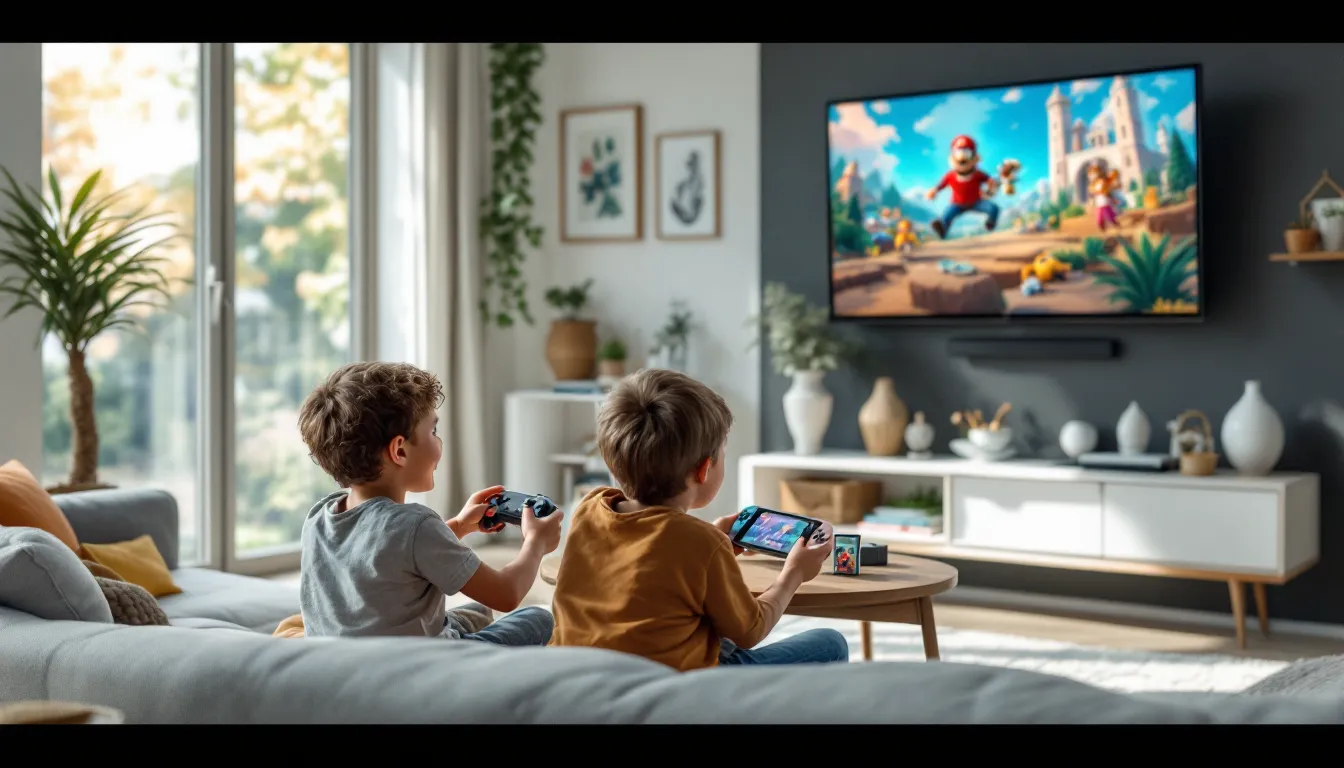
The Nintendo Switch has become the go-to platform for younger players, and it’s not by accident. The console’s hybrid design, docked, tabletop, or handheld, means a 7-year-old can play on the TV with friends or continue their adventure on the bus. That flexibility is huge for parental peace of mind and child engagement.
Beyond the hardware, Nintendo’s first-party games are built with accessibility in mind. Titles like Super Mario Odyssey and The Legend of Zelda: Breath of the Wild feature optional difficulty modes and forgiving checkpoint systems. Kids can experiment without losing hours of progress to a single tough boss. The controls are intuitive, Joy-Con grip, traditional layout, or even motion controls, so younger players don’t get frustrated wrestling with complex button combinations.
The eShop also makes curation easier. Parents can filter by age rating (E for Everyone ratings dominate the library), see playtime estimates, and check multiplayer options at a glance. The Switch’s parental control system is robust too, letting you set screen time limits and restrict content by rating. For a platform that needs to appeal to both kids wanting fun and parents wanting safety, the Switch hits the mark consistently.
Top Rated Nintendo Switch Games For 7-Year-Olds
Adventure & Exploration Games
Super Mario Odyssey is the gold standard here. Mario’s possession mechanic (capturing enemies and objects with Cappy) keeps the gameplay fresh across 15+ kingdoms. Levels scale beautifully, young players can wander, collect moons, and experiment without brutal fail states. It’s not just kid-friendly: kids genuinely love it.
The Legend of Zelda: Link’s Awakening is a remake of the classic Game Boy title with a storybook art style that screams “accessible.” Dungeons are short (perfect for short attention spans), and there’s minimal backtracking. Kids feel like adventurers solving puzzles, not grinding through padding.
Kirby and the Forgotten Land delivers pure joy. Kirby’s copy abilities make every enemy interesting, and the co-op mode is smooth enough that a parent can jump in for a level or two. The difficulty ramps gently, so challenge never feels unfair.
Donkey Kong Country: Tropical Freeze is harder than the others but rewarding for determined 7-year-olds. The 2D platforming is crisp, visuals pop, and co-op lets a sibling share the load.
Puzzle & Brain Games
Picross S9 and the wider Picross S series are deceptively engaging. Kids work through nonogram puzzles at their own pace with zero time pressure. It’s meditative and teaches logical thinking without feeling educational.
Captain Toad: Treasure Tracker wraps puzzle-solving in a charming action-adventure. Each level is a compact diorama to explore and manipulate. No enemies attack: the challenge is purely spatial problem-solving.
Portal 2 lands here if your kid is a bit older (closer to 8-9) and enjoys brain-teasers. The co-op mode is fantastic, and the humor appeals to all ages. Levels teach problem-solving through play.
Puyo Puyo Tetris combines two classic puzzle franchises. It’s easier to learn than it sounds, and the variety keeps kids engaged. Plus, multiplayer means local competition without violence.
Sports & Multiplayer Games
Mario Kart 8 Deluxe remains the king. Smart-steering and auto-accelerate modes let younger players participate fully while still learning the basics. Local multiplayer is seamless, and online play (with parental permission) opens doors to friendly racing.
Super Smash Bros. Ultimate is a fighter, but it’s extremely approachable. With 89 characters and multiple difficulty levels, there’s something for every skill. The Spirits mode offers single-player fun against AI opponents with different rulesets.
Mario Party Superstars and Mario Party 10 are turn-based party games that don’t require gaming skill, just fun competition. They’re loud, chaotic, and perfect for family game nights or sleepovers.
Tennis World Tour 2 and Nintendo Switch Sports (tennis, bowling, chambara dueling) work well for 7-year-olds. Pick-up-and-play controls mean the whole family can participate without extensive practice.
Creative & Building Games
Animal Crossing: New Horizons is an island life sim where kids design homes, catch bugs, and interact with cute villagers at their own pace. There’s no fail state, no time limit, just creativity and relaxation. It’s therapeutic for kids who get anxious about competition.
Minecraft (handheld or docked) is still the ultimate sandbox. Kids build, explore caves, and tinker with redstone logic at their own speed. The Survival mode has gentle difficulty, and Creative mode removes threats entirely. Minecraft Legends Nintendo Switch offers a more guided experience if traditional Minecraft feels too open-ended.
LEGO games (LEGO City Undercover, LEGO Super Mario, etc.) combine light puzzles with creative building. They’re accessible, co-op friendly, and tied to familiar franchises.
Splatoon 3 isn’t a builder, but it deserves a mention for its creative twist on shooters, no guns, just painting terrain. The game is E for Everyone, has robust parental controls within matches, and rewards strategy over reflexes.
Classic Nintendo Franchises Kids Love
Mario Series Essentials
Super Mario 3D World is a 3D platformer that scales brilliantly for younger players. The co-op campaign is the star, up to four players tackle levels together, with occasional competitive moments. It’s chaotic fun, not frustrating.
Super Mario Bros. Wonder takes the 2D formula and injects pure creativity. Power-ups transform Mario in wild ways (he becomes a drill, a parachute, an elephant), and levels shift with these mechanics. Kids feel clever figuring out how to use each power.
New Super Mario Bros. U Deluxe is the safest 2D choice, familiar formula, tight controls, and a help mode that lets a second player place platforms mid-level if the main player struggles.
Zelda Games For Younger Players
The Legend of Zelda: Breath of the Wild is worth mentioning even though being more open. Kids can tackle shrines in any order, climb any mountain, and stumble into secrets everywhere. It rewards curiosity, not memorization. Yes, it’s rated E10+ (ages 10+), but many 7-year-olds thrive here with light parental guidance on tackling the harder dungeons.
Link’s Awakening (mentioned above) is the better fit for strict age 7. It’s shorter, more guided, and visually charming.
Pokemon Titles To Consider
Pokémon Scarlet and Violet are the current entries. They’re open-world RPGs with light story progression, so kids set their own pace. The turn-based battle system is perfect for younger players who might struggle with real-time action. Be aware: performance dips in late-game areas, and the level curve can punish overleveling. Even though these flaws, kids love the collecting and exploration aspects.
Pokémon Let’s Go Pikachu/Eevee is gentler for 7-year-olds, shorter story, easier battles, and nostalgic appeal for parents. It’s linear, which is nice for kids who prefer guidance over total freedom.
What To Look For When Choosing Games
Age Ratings & Content Guidelines
Nintendo’s system is straightforward: E (Everyone) and E10+ (10+) are the safe zones for 7-year-olds. T (Teen, 13+) games should generally be skipped unless your kid is genuinely mature and the game’s content aligns with your family values. Most of the recommendations above are E or E10+.
Read the ESRB descriptor on the back or eShop page. “Animated violence” in a Mario game looks nothing like violence in even the mildest T-rated title. “Suggestive themes” in an E10+ game is usually harmless.
Gameplay Difficulty & Progression
Look for games that scale difficulty or offer assist modes. Super Mario games have “assist mode.” Pokémon has level scaling. Kirby has copy abilities that let younger players handle tough spots differently. Avoid games with punishing lives systems or brutal difficulty spikes, a 7-year-old shouldn’t be resetting the same section fifty times.
Check if a game has checkpoints or save anywhere. Lengthy levels without saves frustrate kids. Short levels (5-15 minutes) keep engagement high and fit into packed schedules.
Single-Player Vs. Multiplayer Options
Consider your household. If there are multiple kids or parents want to join, prioritize games with solid co-op: Mario Kart, Mario Party, Mario 3D World, Kirby, Donkey Kong Country. Solo players gravitate toward Zelda, Pokémon, Animal Crossing, or Minecraft.
Some games shine with asymmetrical multiplayer, one person drives while another shoots in games like some LEGO titles. This keeps everyone engaged without requiring equal skill.
Budget-Friendly Games & Value Picks
Not every great game costs $60. The Switch eShop is loaded with solid titles under $20.
Hollow Knight is a 2D adventure-platformer that rivals full-priced games in content and artistry. At $15, it’s a steal, though it’s marked E10+ and skews toward patient, skilled players. Younger kids might find it tough: 8+ is the sweet spot.
Celeste is a pixel-art platformer about climbing a mountain. It’s challenging but fair, with assist options that let weaker players enjoy the story. $20 for a game that takes 8+ hours is solid value.
Stardew Valley is a farming sim that costs $15 and offers 50+ hours of relaxation. A 7-year-old can manage the basic systems, and there’s no pressure.
Shovel Knight is a 2D adventure-platformer inspired by classic NES games. $15 and fantastically crafted. It’s harder than Mario but has checkpoint flags and fair difficulty.
Spiritfarer is a cozy management game about ferrying spirits across a river. Gorgeous art, touching story, and $18. It’s rated T10+ due to themes around death, but it handles them beautifully and age-appropriately.
Turnip Boy Commits Tax Evasion (silly title, serious charm) is a puzzle-adventure under $15 with big personality and solid replay value.
These underrated gems prove price doesn’t equal quality. Fighting Games for Nintendo Switch and other specialty categories also have budget options worth exploring if those genres appeal to your kid.
Free-To-Play Games Worth Downloading
The Switch’s free-to-play library has improved drastically. Not every F2P game is a money trap.
Fortnite is the obvious choice if your kid is into battle royales. It’s free, cross-play compatible, and can you get Fortnite on Nintendo Switch is a question many parents ask, yes, you can, and it runs surprisingly well on handheld. The Switch version has full parental controls to limit voice chat and matchmaking. Be aware it’s rated T (Teen): the violence is cartoony, but parents should decide if it’s appropriate.
Pokémon UNITE is a team-based strategy game where players level up and evolve Pokémon mid-match. It’s E for Everyone, and you’re never pressured to spend. Cosmetics are the only purchases.
Smash Flash 2 is fan-made and completely free, a flash fighting game with a huge roster. It’s more hardcore, though, and not beginner-friendly.
Paladins is a free team shooter. It’s T-rated and more complex than Fortnite, but f you have older kids (closer to 8-9), it’s worth a look. The game rewards strategy over raw reflexes.
Mario Kart Live: Home Circuit requires a physical kart (around $100), but once you own it, the game is free. It’s unique, the kart’s camera projects onto your TV, mixing physical and digital play. It’s brilliant for active play.
The golden rule with F2P: if a game pressures you to spend within the first hour, skip it. Games that separate cosmetics from gameplay are keepers. Be sure to set parental controls to prevent accidental in-game purchases: even “free” games can drain accounts fast if a curious kid finds the shop.
Parental Controls & Safety Tips
Nintendo’s parental controls are genuinely robust. Access them through System Settings > Parental Controls and set a PIN only you know. From there, you can restrict content by rating (E only, E and E10+, etc.), set daily playtime limits with warnings, and block specific games entirely.
For online multiplayer, disable voice chat or restrict it to friends only. Many games have built-in options too, Fortnite and Splatoon let you toggle this in their own settings. This prevents your kid from hearing random strangers online.
Set expectations around screen time early. A 7-year-old doesn’t need unlimited access. 1-2 hours on school days, maybe 3-4 on weekends, is reasonable depending on your family rules. The Switch’s built-in timer sends warnings so kids aren’t blindsided when their playtime ends.
Enable Friend Request notifications and review new friends. This doesn’t guarantee safety, but it keeps you aware. Teach your child never to share personal information (name, school, address) with online players, even if they seem friendly.
Use the News/Event notifications to stay informed. Nintendo posts tips on parental controls and online safety regularly. Sites like Nintendo Life also publish safety guides and detailed content reviews.
For physical safety, ensure adequate lighting while playing handheld mode, and encourage breaks every 30-45 minutes. Gaming posture matters for developing spines, so remind kids not to hunch.
Finally, model healthy gaming habits yourself. Kids who see parents obsess over phones and screens won’t take “balance” seriously.
Conclusion
The Nintendo Switch library for 7-year-olds is legitimately fantastic. Whether your kid craves colorful adventures (Mario, Kirby), open-world exploration (Zelda, Minecraft), competitive fun (Mario Kart, Smash Bros), or chill creativity (Animal Crossing), there’s a game built for them. The platform’s accessibility, assist modes, scalable difficulty, short play sessions, and robust parental controls, makes it the safest bet for younger gamers.
Start with a franchise you recognize (Mario, Pokémon, Zelda). Most Nintendo first-party games are quality-assured and age-appropriate. Then branch into hidden gems on the eShop. Don’t feel pressured to buy every “best of” list: your kid’s preferences matter more than critical consensus. A moderately fun game they choose beats a critically acclaimed game they’re bored by.
Monitor playtime, engage with the stories and challenges yourself when possible, and update parental controls as your kid grows. The goal isn’t restriction, it’s partnership. Gaming isn’t evil: mindless, unlimited gaming is. With intentional choices and clear boundaries, the Switch becomes a platform for genuine joy and learning. Your 7-year-old is lucky to have access to this library. Use it well.